- Offerings
- Tools & Platforms
Tools & Calculators
- Open API
- Calculators
- SIP Calculator
- CAGR Calculator
- Compound Interest Calculator
- FD Calculator
- RD Calculator
- EPF Calculator
- Retirement Calculator
- HDFC SIP Calculator
- Mutual Fund Return Calculator
- Lumpsum Calculator
- Step Up SIP Calculator
- ETF SIP Calculator
- Brokerage Calculator
- Equity Margin Calculator
- SWP Calculator
- EMI Calculator
- MTF Calculator
- Pricing
- SKY Learn
- Mutual Funds
- Margin Trading
- Financial Planning
- Personal Finance
- Share Trading
- IPO
- Derivatives
- Currencies
- Intraday Trading
- Trading Strategies
- Demat Account
- Commodity
- ETF
- What is Open Interest in Options?
- How Does Open Interest Work?
- Importance of Open Interest
- Open Interest vs Trading Volume
- Benefits of Using Trading Volume Data and Open Interest
- How Do Traders Use Open Interest in Trading Strategies?
- Indicators for Analysing Open Interest
- Conclusion
- FAQs on What is Open Interest in Options?
- What is Open Interest in Options?
- How Does Open Interest Work?
- Importance of Open Interest
- Open Interest vs Trading Volume
- Benefits of Using Trading Volume Data and Open Interest
- How Do Traders Use Open Interest in Trading Strategies?
- Indicators for Analysing Open Interest
- Conclusion
- FAQs on What is Open Interest in Options?
What is Open Interest in Options & How Does Open Interest Work?
By Ankur Chandra | Updated at: Oct 17, 2025 06:07 PM IST
Open Interest in options trading refers to the total number of outstanding option contracts that have not been settled or closed. It indicates market activity and liquidity helping traders gauge interest levels in specific strike prices or expiry dates. High open interest suggests strong market participation, while low open interest may indicate weak momentum.
What is Open Interest in Options?
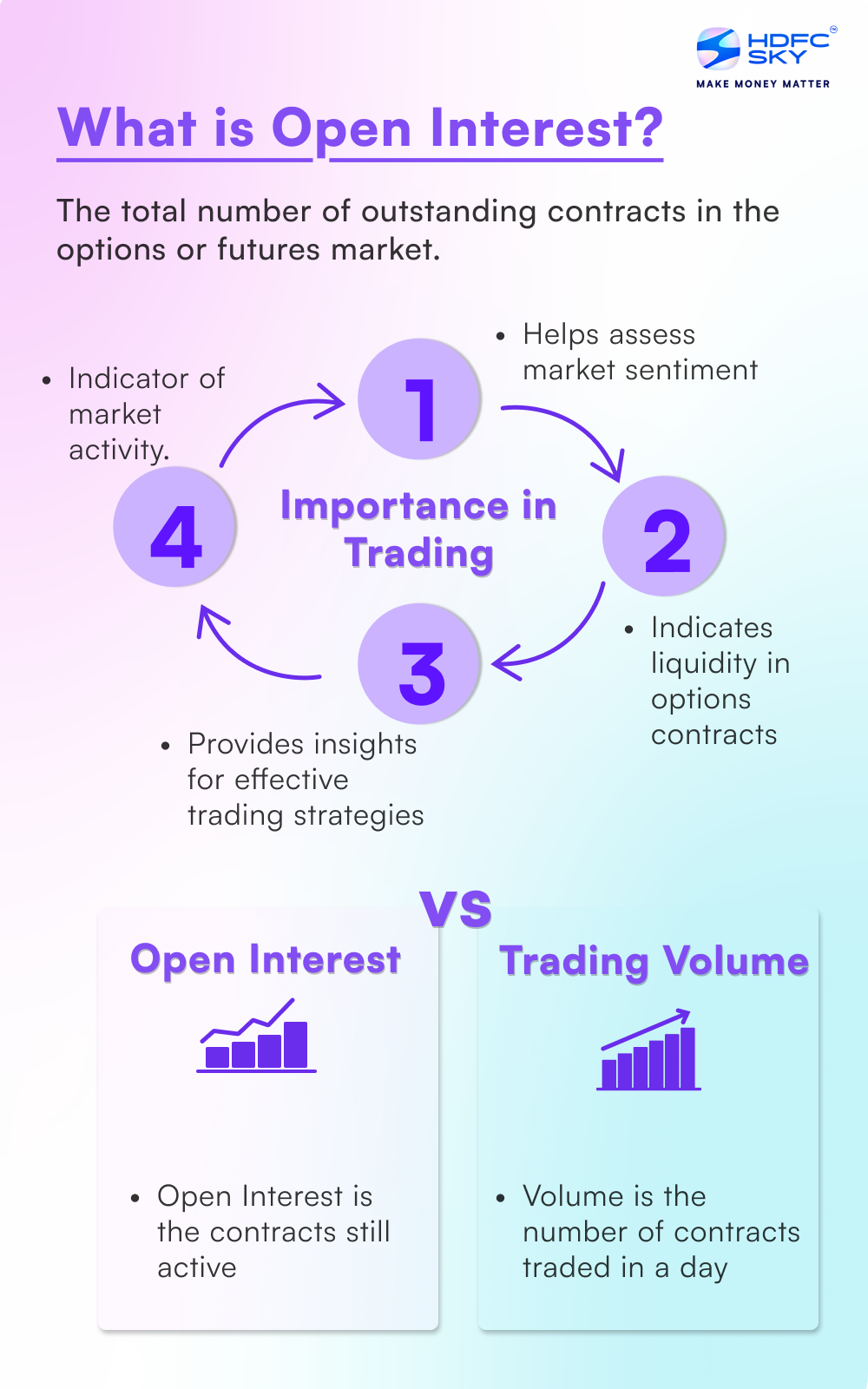
Open interest represents the total number of outstanding options contracts that market participants currently hold. It is not the number of contracts traded in a day but the number of contracts that have not been exercised, closed out or expired.
How Does Open Interest Work?
Open interest increases when new contracts are created and decreases when contracts are closed. It is important to remember that every option trade involves both a buyer and a seller.
- New Contract: Open interest increases by one when a new option contract is initiated.
- Closing an Existing Contract: When a trader who previously bought an option sells it or someone who sold an option buys it back to close their position, open interest decreases by one.
Example: You can think of a 100 new call option contracts for a particular stock are bought. Open interest increases by 100. Later 50 of those contracts are sold to close out positions. Now, open interest is reduced to 50.
Importance of Open Interest
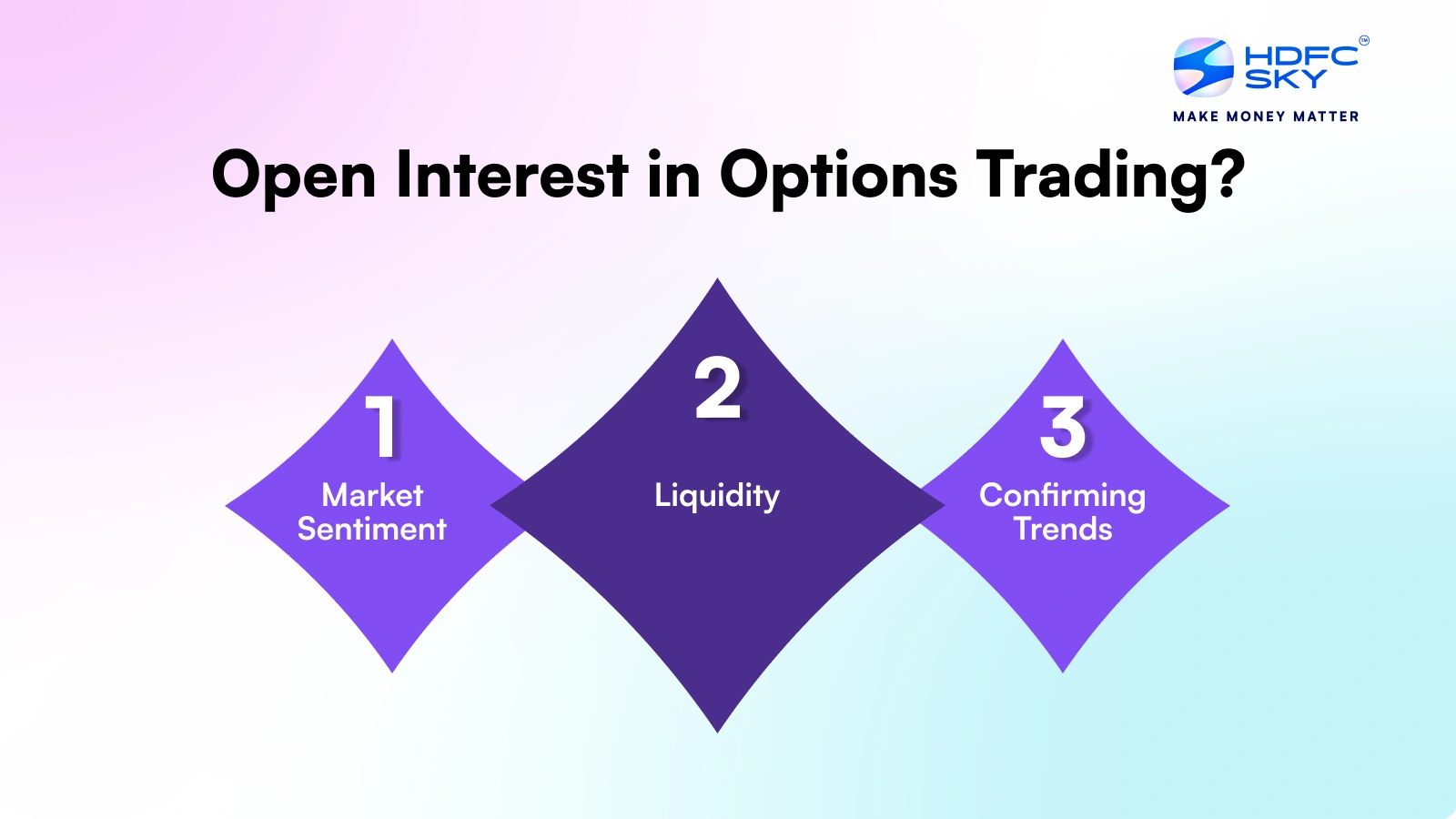
Open Interest is a vital indicator in options trading that reflects the strength of market trends and trader sentiment. It helps identify liquidity, trend confirmation and potential reversals.
- Market Sentiment Gauge: High open interest signals strong participation, indicating bullish or bearish confidence.
- Liquidity Indicator: Higher open interest ensures better trade execution and tighter spreads.
- Trend Confirmation: Rising prices with rising open interest confirm a strong trend.
- Potential Reversals: Falling open interest may signal trend weakening or profit booking.
- Helps in Strategy Planning: Traders use it alongside price and volume to plan entry and exit points effectively.
Open Interest vs Trading Volume
While both open interest and trading volume provide insights into market activity, they represent different aspects:
- Open Interest indicates the total number of outstanding contracts. It is a measure of the current market commitment to a particular option.
- Trading Volume represents the number of contracts traded during a given period. It reflects the level of activity and interest in the option.
Open Interest and Trading Volume are key metrics in options trading but they measure different aspects of market activity.
| Aspect | Open Interest | Trading Volume |
| Definition | Total number of outstanding contracts | Number of contracts traded in a day |
| Indicates | Market liquidity and interest | Market activity for the day |
| Updated | End of each trading day | Real-time during trading hours |
| Reflects | Long-term market commitment | Short-term buying/selling interest |
| Can Decrease? | Yes, if contracts are closed | No, it resets daily |
| Used For | Gauging overall market sentiment | Spotting immediate interest or momentum |
| When Useful | Planning strategy over days/weeks | Intraday or short-term strategies |
Benefits of Using Trading Volume Data and Open Interest
Trading volume and open interest provide key insights into market strength and trader activity. Together, they enhance decision-making in options trading.
- Confirms Market Trends
- Identifies Entry and Exit Points
- Measures Market Participation
- Detects Price Breakouts or Reversals
- Improves Risk Management
- Helps Analyse Trader Sentiment
- Supports Strategy Validation
How Do Traders Use Open Interest in Trading Strategies?
Traders analyse Open Interest (OI) to assess market sentiment, spot trends and confirm price movements. Here’s how it’s used in strategies:
- Confirming Trends
- Rising OI with rising price = bullish trend confirmation.
- Rising OI with falling price = bearish trend confirmation.
- Identifying Reversals
- Falling OI with rising/falling price can indicate a weakening trend or potential reversal.
- Spotting Breakouts
- Sudden spike in OI along with increased volume suggests strong interest and possible breakout.
- Avoiding False Signals
- Low OI may indicate lack of participation traders often avoid trading in such conditions.
- Support and Resistance Zones
- Strike prices with highest OI can act as potential support/resistance levels.
- Tracking Smart Money
- Large OI build-up in specific contracts may signal institutional or “smart money” positioning.
Open Interest helps traders make more informed entries and exits, especially when combined with price action and volume analysis.
Indicators for Analysing Open Interest
Open Interest (OI) alone can be insightful but combining it with other indicators helps traders make better decisions. Key indicators include:
- Price + OI Relationship
- Price up + OI up = Strong bullish trend
- Price down + OI up = Strong bearish trend
- Price up/down + OI down = Weakening trend or profit booking
- Volume + OI
- Rising volume with rising OI confirms trend strength.
- Low volume with high OI may indicate uncertainty.
- Put-Call Ratio (PCR)
- PCR based on OI shows market sentiment.
- High PCR = bearish bias, Low PCR = bullish bias
- Max Pain Theory
- Identifies the strike price where maximum options buyers lose money used to predict expiry price levels.
- Support and Resistance via OI Buildup
- Strike prices with highest OI in calls = resistance
- Highest OI in puts = support
- Change in OI
- Sudden spikes in OI can signal new positions and potential volatility.
These indicators, when combined, offer a clearer picture of market psychology and potential price movements.
Conclusion
Traders across the globe consider open interest as a valuable tool for options trading. Options trading might seem complex and open interest is an integral part of it. You can start by understanding its meaning, its significance and how it interacts with other market indicators, traders can make more informed decisions. Whether assessing market sentiment, confirming trends or identifying potential reversals, open interest can provide valuable insights that can enhance your option trading strategies.
Related Articles
FAQs on What is Open Interest in Options?
How can one identify market trends using open interest?
Rising prices with increasing open interest often indicate a strong uptrend, while falling prices with increasing open interest suggest a downtrend. Decreasing open interest can signal weakening momentum, regardless of price direction.
Where can you use the open interest ratio?
The open interest ratio, like the Put-Call Ratio, is used in options trading to gauge market sentiment and potential price trends by comparing open interest in different types of options.
What is a high OI option?
A high OI option is an options contract with a large number of outstanding contracts. This generally indicates high liquidity and active trading in that particular option.
Can open interest be zero?
Yes, open interest can be zero. If there are no outstanding contracts for a particular option, this indicates very low activity or interest.
Does open interest indicate a bearish or bullish trend?
Open interest does not directly indicate a bearish or bullish trend. It must be analysed along with price action and other indicators to understand market sentiment and potential trends.
What is open interest and volume in options?
Open interest is the total number of outstanding options contracts, while volume is the number of contracts traded in a given period. Both provide insights into market activity and liquidity.
What is a change in open interest in the option chain?
The change in open interest in the option chain shows how the number of outstanding contracts has changed over time. Increasing open interest often suggests growing interest in an option.
What does a high or low open interest tell about an option's popularity?
High open interest generally indicates higher popularity and liquidity for an option, while low open interest suggests lower popularity and potentially wider bid-ask spreads.